24.04.2026 • Forschung
Mid-Infrared Spectroscopy and Machine Learning for Chlorogenic Acid Quantification in Coffee
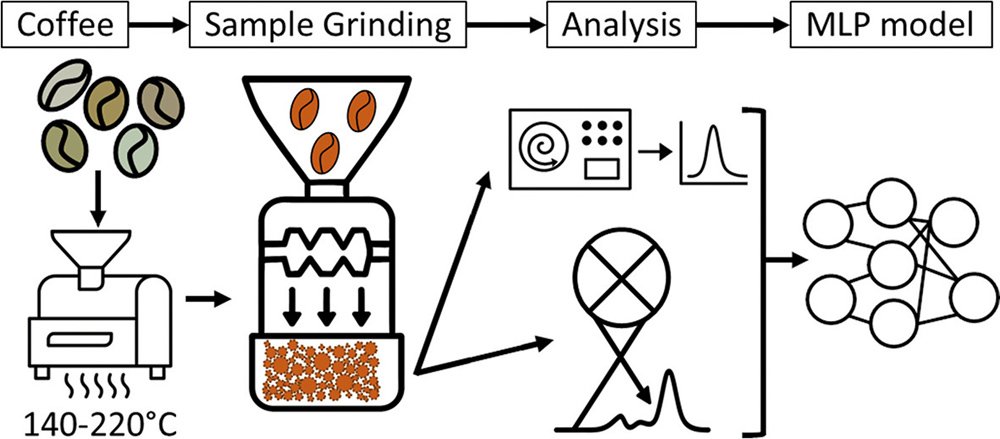
To predict chlorogenic acid (CGA) concentration in coffee during roasting, a machine learning algorithm was applied to mid-infrared (MIR) data.
© Technical University of Applied Sciences Mannheim
A total of 44 roasting samples between 140 and 220 °C, along with an unroasted control, were dry-heated in an eddy current roaster and subsequently ground and measured. CGA concentrations were predicted from MIR spectroscopy data using a multilayer perceptron (MLP) regressor and validated against a high-performance liquid chromatography with diode array detector reference. The algorithm performed spectral preprocessing and selected relevant wavenumber regions. The MLP-based model achieved a high coefficient of determination, outperforming classic peak evaluation, indicating that automated wavelength selection improves predictive accuracy.
Deborah Herdt, CeMOS—Research and Transfer Center, Technical University of Applied Sciences Mannheim