AI- and Image-Based Analysis of Emulsification Processes: Opportunities and Challenges
Smart sensor systems for process analysis are of special interest in process industry. The development and application of an image-based sensor for real-time monitoring and evaluation of liquid–liquid processes is presented.
Autor: Inga Burke-Oeing (née Burke), Department of Biochemical and Chemical Engineering, Laboratory of Equipment Design, TU Dortmund University
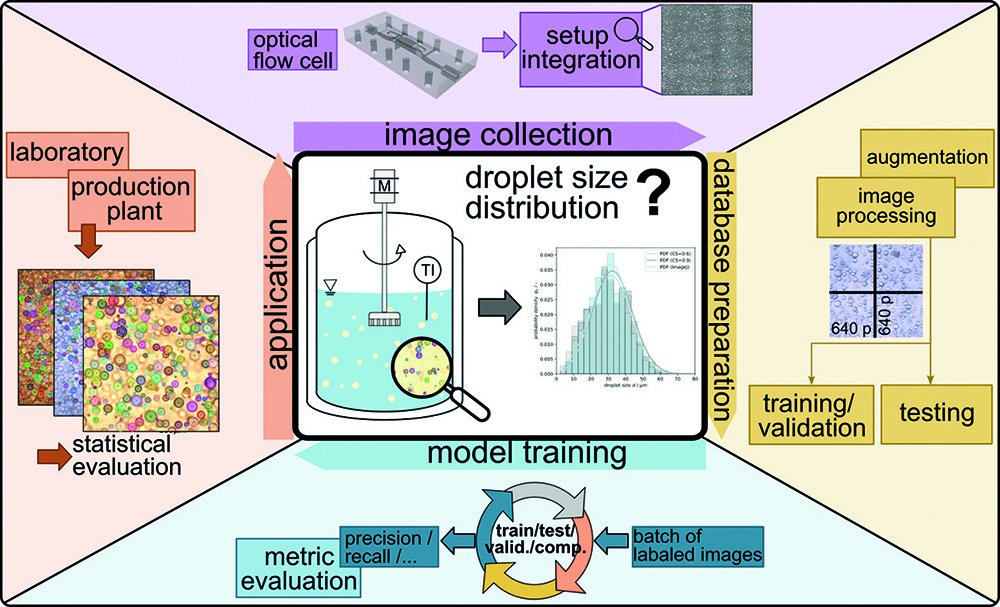
The sensor system is integrated into an automated setup, and different versions of the single-stage object detector You Only Look Once (YOLO) are investigated for their application on an edge device. YOLOv4, YOLOv7, and YOLOv7 tiny models were trained on a diverse dataset, including laboratory, industrial, and synthetically generated data. YOLOv7 tiny demonstrated comparable detection accuracy to YOLOv7 while achieving significantly faster inference (6.4 vs. 13.7 s for 30 images with >10 000 droplets). The use of synthetic and CycleGAN-textured datasets enhances model robustness. Key requirements and challenges using real-time object detection in emulsification process monitoring are highlighted for laboratory and industrial applications.
Inga Burke-Oeing (née Burke),
Department of Biochemical and Chemical Engineering, Laboratory of Equipment Design, TU Dortmund University ·