Machine Learning–Enhanced Fischer–Tropsch Synthesis
Optimizing Catalysts and Process Conditions for Efficient Fuel Production
Univ.-Prof. Dr.-Ing. Harvey Arellano-Garcia, Brandenburgische Technische Universität Cottbus-Senftenberg, Fachgebiet Prozess- und Anlagentechnik
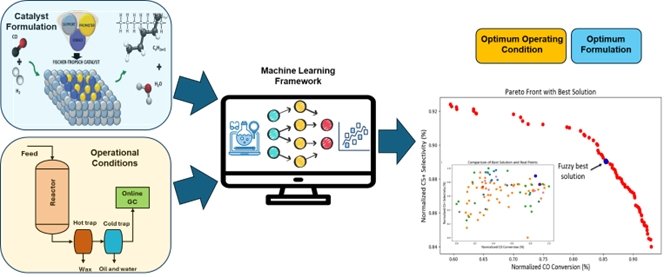
Fischer–Tropsch synthesis (FTS) offers a promising route for producing clean, renewable fuels. Yet, designing efficient catalysts and determining optimal process conditions remain major hurdles. Machine learning (ML) provides powerful means to address these challenges. Despite their potential, metal/zeolite catalysts are scarcely studied in ML-driven FTS research. This work applies an ML-based framework to model and optimize metal/zeolite catalysts for liquid fuel synthesis via FTS. Supervised learning methods reveal key structure–performance correlations, whereas multi-objective optimization identifies ideal catalyst and process parameters. The top solution is benchmarked against nearest experimental data. Results show CatBoost as the best-performing model, with Pt–Co/Beta treated with NaOH and NH4+ emerging as the optimal catalyst.