13.03.2026 • Forschung

Experimental Parameter Study of the Factors Influencing Dry Dispersion Using Laser Diffraction

The optimization of dispersion processes is crucial for the particle size of the end product and the increase in efficiency of such processes.

Autor: Joscha Witte, Institute of Particle Technology, University of Wuppertal
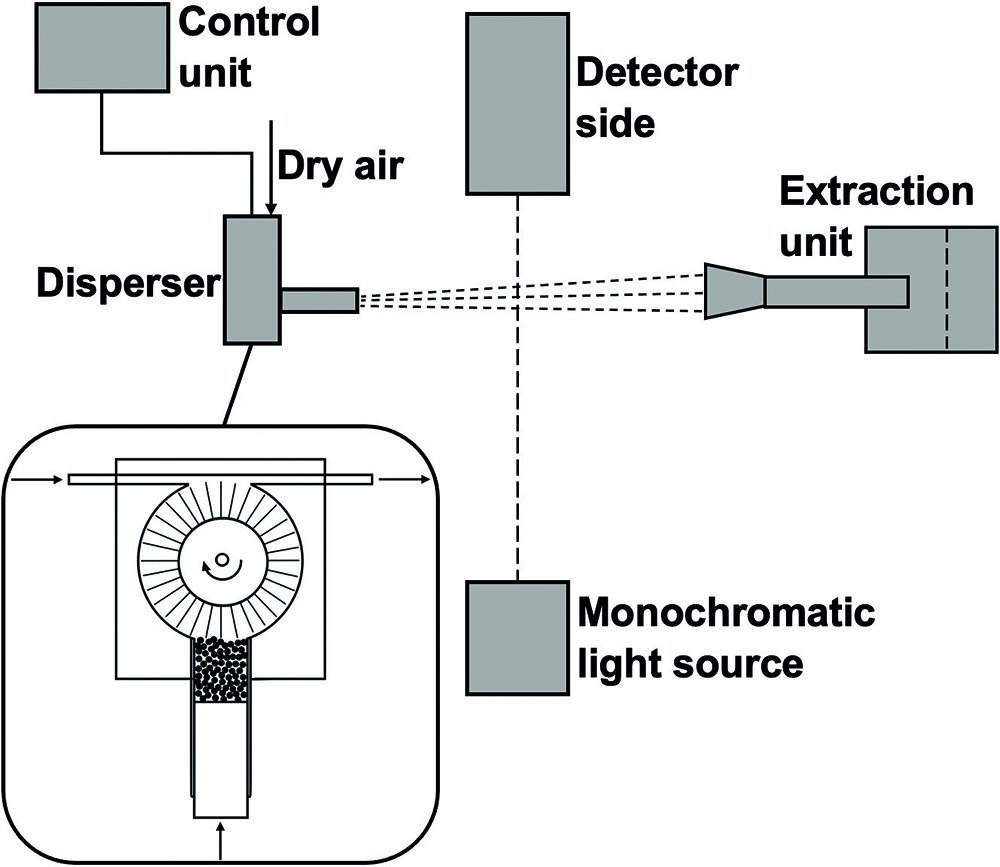
Schematic top view of the experimental setup used, consisting of brush disperser (1), external control unit (2), dry air supply (3), monochromatic light source (4), detector side of laser (5) and extraction with filter unit (6) with working distances from measuring zone to disperser exit WDe and to lens of detector WDL, as well as the schematic functional principle of the disperser, consisting of feed movement (a), feed piston (b) solid tank (c), powder (d), dispersing head (e), brush (f), air (g) and aerosol (h).
© University of Wuppertal

The aim is to optimize a dry dispersion process by adjusting relevant process parameters, which are relevant for gas phase mixing processes. Laser light diffraction is used to analyze the influence of various factors on the particle size distribution of submicron LiFePO4. The investigation focuses on geometric (tube size, work distance), material-related (pre-treatment, brush), and operating parameters (mass and volume flow). The results allow conclusions to be drawn about the dispersing effect of these parameters, which can provide valuable information for optimizing dry dispersion processes and the product quality in subsequent process steps.

Joscha Witte
Institute of Particle Technology, University of Wuppertal

DOI: 10.1002/cite.70039

Anbieter

Bergische Universität Wuppertal

Gaußstraße 20
42119 Wuppertal
Deutschland

Kontakt zum Anbieter


Ethernet-APL

Automatisierung der Prozessindustrie mit Ethernet-APL

Automatisierung der Prozessindustrie mit Ethernet-APL

Ethernet-APL erfüllt zentrale Anforderungen moderner Prozessautomatisierung – in Theorie und Praxis. Lesen Sie hier mehr zur Technik, über Anwendungen und Nutzen.

Themenspotlight

Wasserstoff für die Prozessindustrie

Wasserstoff für die Prozessindustrie

Wasserstoff gilt als eines der Schlüsselmoleküle für die Energiewende und die Transformation der Chemieindustrie. Lesen Sie gesammelt alle Inhalte rund um das Thema Wasserstoff in der Prozessindustrie.

Meist gelesen