Machine-Learning-Enabled Structural Design and Optimization of Methanol Reforming Hydrogen Reactors
A methanol steam reforming and combustion channel reactor was developed to supply hydrogen for high-power fuel cells.
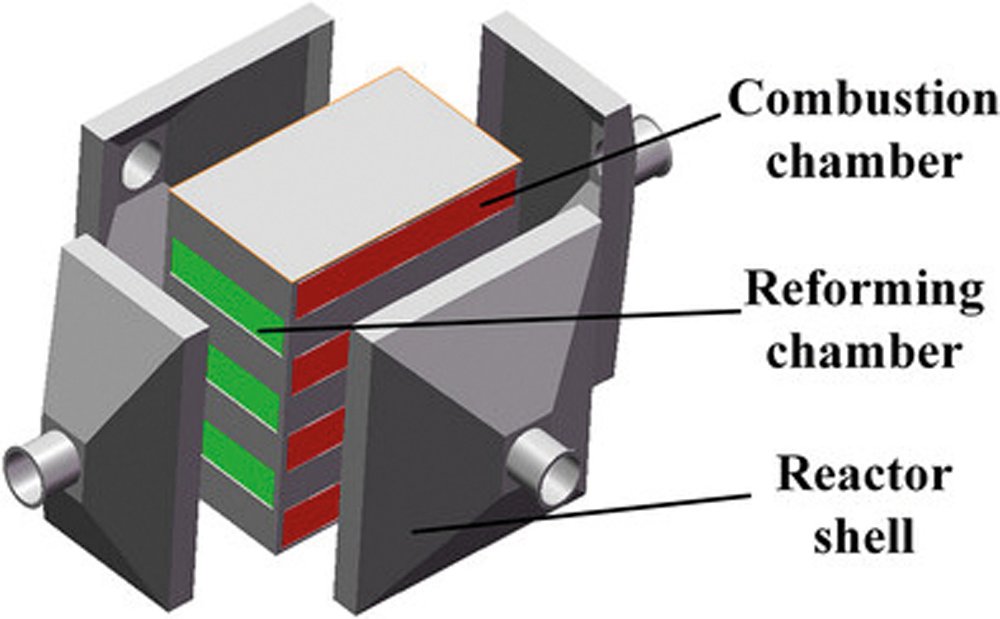
Numerical simulation combined with a backpropagation (BP) neural network, whose maximum error is below 5%, quantified how channel dimensions and inlet flows influence peak temperature difference, flow maldistribution, methanol conversion, and hydrogen output. Multi-objective optimization using non-dominated sorting genetic algorithm II (NSGA–II) yielded the optimal layout: length 284 mm, width 171 mm, combustor inlet flow 8.3 × 10³ mL min−1, and reformer inlet flow 4.7 × 10⁴ mL min−1. Compared with the initial design, the optimized reactor reduces peak temperature and flow differences by 6.6% and increases methanol conversion and hydrogen production by about 7%, meeting the hydrogen demand of roughly 23 kW fuel cells.
Dr. Weitao Wu, Zhejiang Provincial Key Lab of Modern Textile Machinery, School of Mechanical Engineering, Zhejiang Sci-Tech University, Hangzhou