Utilization of Waste Materials Using the Müller–Kühne Process—A Life Cycle Inventory Study
The declining availability of sulfuric acid in Europe potentially creates a critical raw material gap.
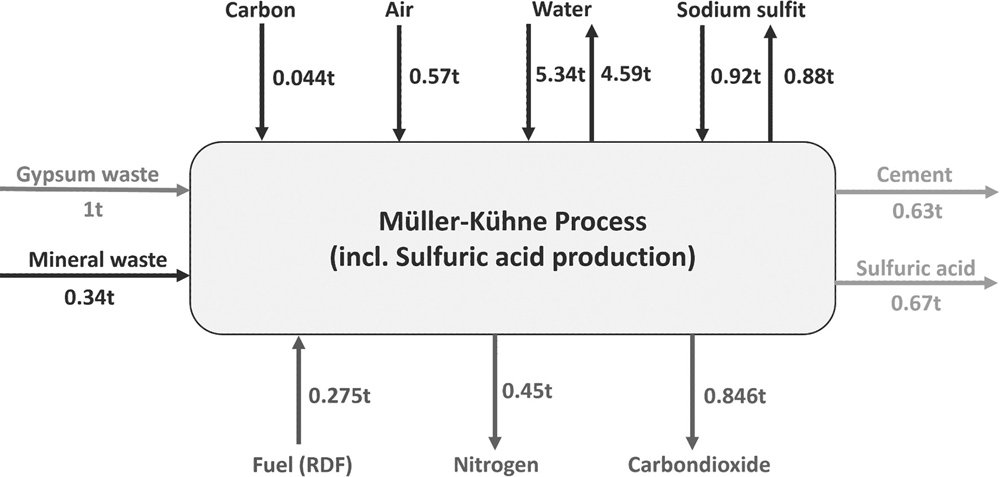
A possible solution to overcome this gap is the Müller–Kühne process (MKP), which converts gypsum waste into sulfuric acid and cement clinker, addressing both a disposal problem and, at the same time, enabling the utilization of complex waste materials for closed material cycles. Here we present a Life Cycle Inventory study of the MKP based on literature data and stoichiometric calculations. The MKP achieves a material yield of 85 %, outperforming conventional cement production, whereas its specific energy demand is higher at 7.45 GJ t−1 of clinker. The inventory serves as a basis for a subsequent life cycle assessment.
Prof. Martin Bertau, Institute of Chemical Technology, Technische Universität Bergakademie Freiberg und
Dr. Philip Biessey, Responsible Process Engineering, Faculty of Mechanical Engineering, Ruhr-Universität Bochum